- Details
-
By Florida State University
New Clues Shed Light on Importance of Earth’s Ice Sheets
Researchers examining subglacial waters both from Antarctica and Greenland found that these waters have higher concentrations of important, life-sustaining elements than previously thought, answering a big unknown for scientists seeking to understand the Earth’s geochemical processes.
“The data from an Antarctic lake is particularly exciting,” said Florida State University postdoctoral fellow Jon Hawkings. “Most people tend to think of Antarctica as just ice, but we’ve known about these lakes underneath the glaciers in Antarctica for 40 years and over 400 of them have currently been identified. Some scientists refer to the subglacial environment in Antarctic as the world’s largest wetland. The challenge for scientists is it’s just extremely difficult to sample them.”
Hawkings, along with colleagues at Florida State and Montana State University, has published a new study this week in the Proceedings of the National Academy of Sciences exploring these subglacial waters.
Read more: Florida State University
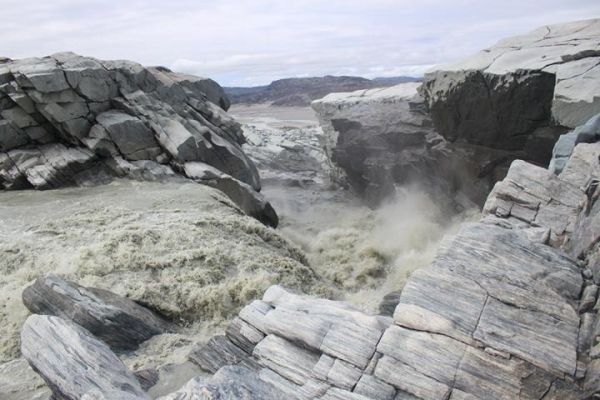
Pictured is a glacial meltwater river that has drained from the Greenland Ice Sheet. These rivers contain high amounts of suspended glacial flour as the ice sheet acts like a natural bulldozer and gives the rivers a grey milky color. (Photo Credit: Jon Hawkings)